
Retail investors usually get caught up in the frenzy of a bull market and burn their fingers in IPOs, warns Tinesh Bhasin.

Mukesh Ambani's Jio Financial Services (JFS) is set to seek shareholders' approval for its leasing subsidiary to acquire telecom equipment and devices worth Rs 36,000 crore ($4.33 billion) from Reliance Retail. Jio Leasing Services Limited (JLSL), a wholly-owned subsidiary of JFS, plans to enter the device leasing business, and the equipment will be deployed in broadband wireless connectivity and other services.

Retail investors have put at least Rs 2,296 crore in listed companies facing proceedings under the Insolvency and Bankruptcy Code (IBC). A median such-company had 16,163 retail investors as shareholders many of whom apparently have bought a stake on the hope of making money if the firm revives. They own a fifth of the total stake in the companies under consideration. The analysis looked at 75 listed firms for whom shareholding data was available for March 2022.

IPOs inherently carry more risks than stocks that have been listed on the exchanges for some time.

With the Bombay Stock Exchange (BSE) benchmark Sensex racing towards its all-time high, retail and high net worth individual (HNI) investors are flocking towards public issues.

Retail investors will soon have to obtain a net worth certificate from a chartered accountant and submit it to their broker, and their trading limits will be decided accordingly.

A key trigger for the increased retail participation in equities has been the lockdown triggered by Covid-19 that saw investors channelising their savings to capital markets in search of better return on their investments and the need to increase their disposable income.

Without changes to the taxation rules, buybacks are expected to remain scarce.

When Gensol Engineering made its public market debut through a small and medium enterprises (SME) initial public offering (IPO) in September 2019, its promoters held a commanding 96 per cent stake. Now, that figure has shrunk to a "negligible" fraction.

'If individual stocks start falling 25% to 30% or more, then I doubt how many of them will be able to withstand that (kind of selloff). That is when you'll see panic coming in.'

Retail investors could be hesitant to invest in floating rate savings bonds, as these specific bonds tend to be profitable only in a rising rate environment, according to market participants. The Reserve Bank of India has allowed subscriptions for floating-rate savings bonds, 2020, via retail direct - an online portal that enables individual investors to purchase government securities.

'Go for a base cover of Rs 10 lakh and then buy a super top-up of Rs 90 lakh.'

SEBI has published data showing that more than 90 per cent of investors lose money in futures and options, explains Harsh Roongta.

LIC's public offer, the country's biggest-ever IPO, saw the policyholders' portion being oversubscribed on the first day itself on Wednesday, though overall subscription stood at just 66 per cent. The government aims to generate about Rs 21,000 crore by selling 3.5 per cent stake in the insurance behemoth. The LIC initial public offering (IPO), open for retail and institutional investors, is set to close on May 9. The issue period also includes bidding on Saturday, May 7.

10 largecaps stocks which stand to gain from the Budget.

'The incentives to switch to the new tax regime... are viewed as a negative due to potential loss of customers who buy policies for saving tax.' 'The tax-saving value proposition for the sector reduces.'

Financial assets make a comeback as returns on physical assets falter.

Sources said many individual investors were interested in applying for the NFO, due to additional benefits being offered such as upfront discounts and loyalty bonuses.

LIC's public offer, the country's biggest-ever IPO, was fully subscribed on the second day of bidding on Thursday. Against 16,20,78,067 shares on offer, 16,68,60,765 bids were received -- translating into a subscription of 1.03 times, as per data on stock exchanges as of 7 pm. However, the Qualified Institutional Buyer (QIB) and Non-Institutional Investor (NII) portions have received a tepid response so far.

People in full-time jobs should especially avoid intraday trading as it results in loss of focus and affects performance.

Her reasoning is simple, "It's a Tata company. No shareholder will let go of this opportunity," she told Business Standard. When asked if the other reason for lining up for the IPO is the technology sector and the fact that the combination of Tata and tech is happening after almost two decades, she replied: "The name of the company and the group matter. Tata means stability and credibility," she added.

These investors are not only betting on little-known stocks, but also sectors that the market participants are not paying much heed to. Some of these stocks can be potential multi-baggers, while others may not live up to the expectations of these stock-pickers, says Jash Kriplani.

Session-wise data indicates small investors have taken money off the table in more sessions than they have pumped in additional capital.

The ownership by domestic investors, individual as well as institutional, in companies listed on the National Stock Exchange (NSE) has breached the 25 per cent mark for the first time. The share stood at 25.72 per cent at the end of the March 2023 quarter, up from 24.44 per cent in the previous quarter, according to data from Prime Database. The share of foreign portfolio investors (FPIs), meanwhile, rose slightly to 20.56 per cent from 20.24 per cent as on December 31, 2022.

The Rs 702-crore IPO received bids for 2,93,41,84,140 shares against the total issue size of 2,32,59,550 shares, according to data available till 3.30 pm on Wednesday.

Finance Minister Nirmala Sitharaman on Tuesday said the securities transaction tax (STT) will be increased on futures and options (F&O) trade from October 1 to discourage retail investors from investing in the risky instrument.

As regards mid-caps and small-caps, analysts suggest investors buy only those stocks of those companies where there is earnings visibility for at least a few quarters and where the valuations have become reasonable.

The two had been accused of making unlawful gains of over 4.94 crore (Rs 49.4 million) by cornering shares of various companies meant for retail individual investors and the penalty is three times of the amount.
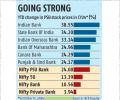
Stock Market News today, PSU banks: The year 2024 was a roller-coaster ride for Indian stock markets, marked by volatility driven by the Lok Sabha elections, Union Budget 2024, a slowdown in corporate earnings, and sticky inflation. Geopolitical tensions - particularly between Israel and Iran in West Asia - along with various stimulus announcements by China and yen carry trade rocked the equity markets throughout the year.

Prime Minister Narendra Modi will on Friday launch two schemes of the Reserve Bank of India (RBI) that may go a long way in changing how the household sector invests, and complains if anything goes wrong with their savings. These schemes - retail direct and an integrated ombudsman - will be launched by the Prime Minister virtually, in the presence of Finance Minister Nirmala Sitharaman. With the introduction of retail direct, a common man can directly take a position in government securities (G-Sec), considered to be the safest asset class a sovereign can offer.

'Retail investors, who had not seen such a massive correction in the SMID universe since COVID-19, are witnessing something like this for the first time. Panic profit booking may continue.'

Water projects firm Vishnu Prakash R Punglia, the 20th company to launch its IPO in the current year, saw its shares closing at a 47 per cent gain over its issue price on Tuesday. Such a huge one-day pop is considered rare; however, it has become the norm this year. The average listing-day gain for these 20 IPOs in 2023 is 34 per cent, and their average gain to date stands at 46 per cent.

Influenced by ads like 'Make money sitting at home', 'Make Rs 10 lakh with just Rs 1,000', to YouTube influencers promoting 'pump-and-dump' stocks, a vast majority of small investors who mushroomed during the COVID-19 period are losing money in reckless overtrading in the market, cautions Dr V K Vijaykumar, Chief Investment Strategist at Geojit Financial Services.

A grooming branch network for servicing HNIs is a stepping stone for a full-fledged wealth management business.

Initial public offerings (IPOs) have attracted droves of retail investors to the stock market in CY22. But these applicants have lost money on 40 per cent of the fresh issues this year - a trend that may impact sentiment towards maiden share sales during the remaining part of the year. Of the 14 companies that have listed this year, five have closed below their issue price.
Allotment could be low, and expected listing-day gains can quickly morph into losses if sentiment takes a turn for the worse
'If you see another 1000-point correction, people may start panicking.'

'Markets are not expensive; they are fairly priced.'

'Just this year alone, close to 40 major transactions involving Bollywood stars have been recorded.'

For longer tenure products, they offer higher returns compared to other instruments. But for shorter tenures, things are getting tighter for investors.
 © 2026 Rediff.com - Advertise with us - Disclaimer - Privacy Policy - Sitemap - Feedback - About us - Terms of use - Grievances